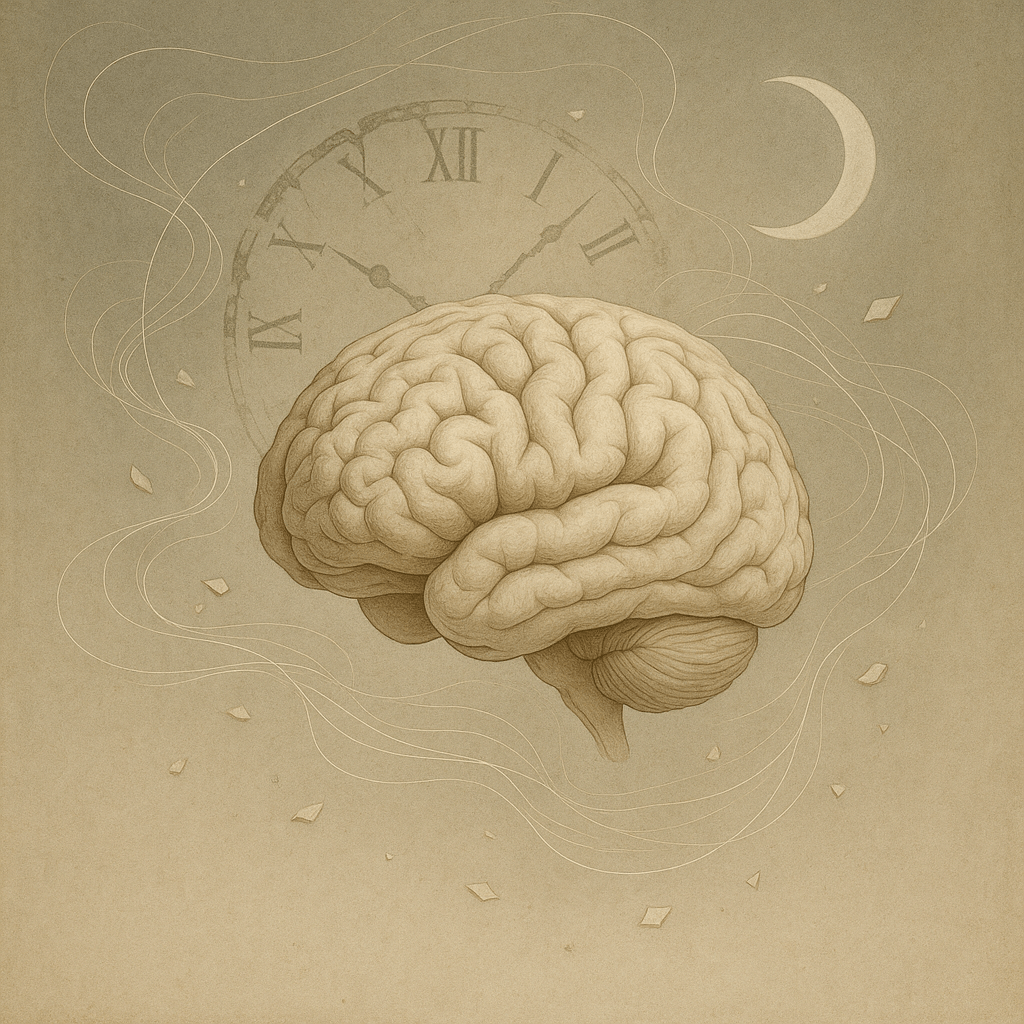
The brain, as Paul Terrence Moore reminds us in his 2022 paper in Frontiers in Human Neuroscience, is first and foremost a self-regulating system. It is not a machine waiting for external command but a living, adaptive organism designed to balance its own rhythms. When that self-regulation falters, however, the consequences can be profound—and few conditions illustrate this more vividly than insomnia.
We tend to dismiss insomnia as the frustrating inability to fall asleep, but Moore reframes it as a sign of something deeper: a breakdown in the brain’s natural capacity to regulate itself. The result is not just a few groggy mornings. Sleep deprivation chips away at us in ways that are both shocking and sobering. Studies show that after a single night without proper rest, our cognitive impairment rivals that of someone legally drunk. The immune system, too, takes a beating—white blood cell counts rise and remain elevated even after a week of recovery sleep, leaving the body in a state of lingering inflammation. Add to this the heightened risk of cardiovascular disease, metabolic disruption, and mood dysregulation, and insomnia emerges not as a nuisance, but as a full-body stressor.
The science of sleep helps us see why. Our rest depends on the delicate dance between two biological processes: the buildup of sleep pressure over time and the circadian rhythms tied to light and darkness. Together, these govern when we drift off and how deeply we rest. Yet in our modern world, where artificial light floods our evenings and stress keeps our nervous systems on edge, this dance falters. The result: brains that cannot downshift into restorative sleep.
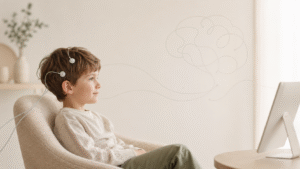
Here is where Moore’s discussion of infra-low frequency (ILF) neurofeedback becomes fascinating. Rather than imposing an external solution—say, a pill that forces sedation—ILF neurofeedback works at an almost subterranean level, below conscious awareness. It provides the brain with real-time feedback about its own activity, nudging it toward more stable rhythms. Think of it less as a command from outside and more like holding up a mirror so the brain can recalibrate itself. The method is not new; as far back as 1970, researchers noticed that training animals to enhance specific brain rhythms led to deeper, more consolidated sleep. What is new is how this technique has been refined to address chronic human insomnia.
The most compelling part of Moore’s paper comes in the form of a case study. A 33-year-old engineer, tormented by years of severe insomnia, headaches, and anxiety, entered treatment with an Insomnia Severity Index score of 25—a clear clinical problem. Over the course of 30 ILF sessions, with a few sessions of Alpha-Theta training added, her transformation was striking. Her insomnia score dropped to 11, her headaches disappeared, and her overall symptoms were cut nearly in half. It was not a miracle; it was her own brain, given the tools to restore its natural rhythm.
What makes this story resonate is not just the science, but the humanity. This was not data in a lab—it was a person whose life was being slowly eroded by sleepless nights and all their downstream effects. And through a method that required no drugs, no invasive procedures, she found her way back to rest. It feels less like a cure and more like a reclamation of something the brain already knew how to do but had forgotten.
Reflecting on Moore’s paper, I am struck by three things. First, how smart the framework is: it asks us to stop treating insomnia as the failure of a symptom and instead see it as the failure of regulation. Second, how shocking the evidence remains: that one bad week of sleep can leave lasting marks on cognition and immunity. And finally, how personal this all is. Sleep is not just a biological necessity; it is the bedrock of our daily humanity. To lose it is to lose clarity, resilience, and often hope. To restore it, as Moore’s case shows, is to restore a kind of quiet wholeness.
In a culture that loves quick fixes, Moore’s work is a reminder that sometimes the deepest healing is subtle, patient, and self-directed. The brain, when given the right feedback, can find its way home. And perhaps that is the most hopeful message of all: even when sleeplessness feels endless, regulation—and restoration—remain possible.